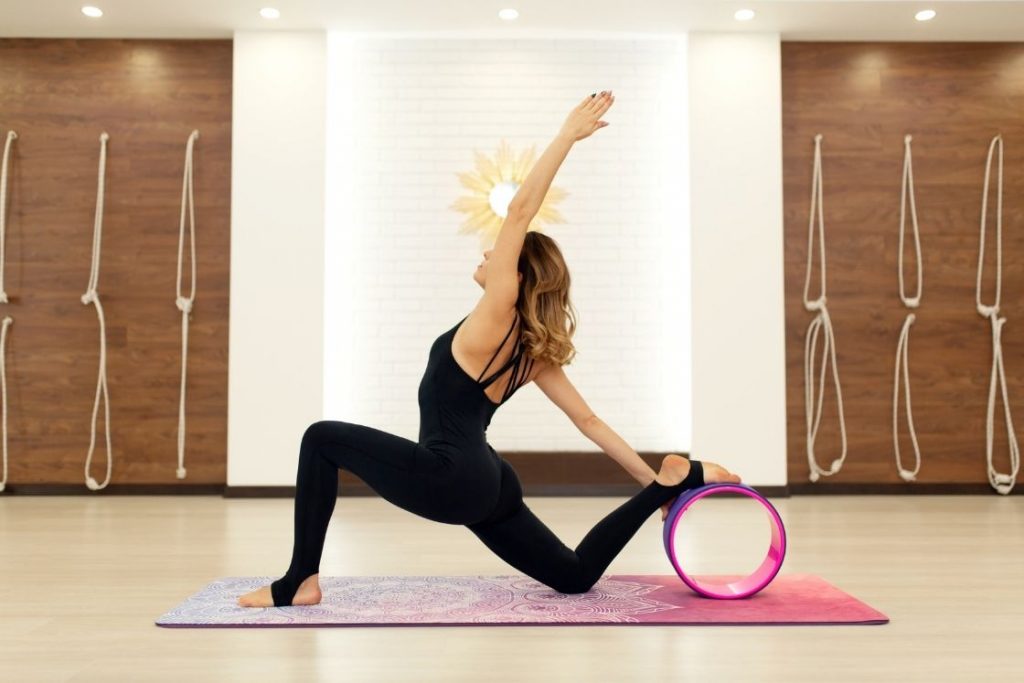
A flexible practitioner can often reach a striking wheel-assisted shape quickly. That does not reveal how the position was entered, whether force was distributed well or whether the person could leave without collapsing. Range is visible, while control is harder to see.
Training with a yoga wheel is therefore less about proving flexibility and more about managing load. The prop can roll, concentrate pressure and extend the distance between support points. A practitioner needs enough strength, awareness and braking capacity to decide how far the movement goes.
Load Includes More Than Body Weight
Load is the demand placed on tissues and the nervous system. Body weight contributes, but so do leverage, speed, duration, repetition and the stability of the support. A gentle-looking hold can become demanding when the wheel is far from the body or when a small muscle group must prevent it from rolling.
Pressure is another part of the experience. The wheel creates a relatively narrow contact area compared with a bolster. The same body weight over a smaller area can feel more intense. Padding may improve comfort, but it does not correct poor positioning.
Fatigue changes load control as well. A setup that feels stable during the first repetition may become unpredictable after several attempts. The appropriate dose depends on the whole session, not just the pose in isolation.
Passive Range and Active Control Are Different
Passive range is movement available with help from gravity, a prop or another person. Active range is the portion a person can create and control using muscular effort. Both can have a place in practice, but they are not interchangeable.
A wheel may carry the spine into a deeper extension than the practitioner can actively manage. The position may feel open while supported, yet the exit can reveal limited control. Similarly, resting a leg on the wheel may permit a larger hip angle than the person can lift independently.
The answer is not to avoid passive movement entirely. It is to choose a range from which muscular participation remains available and the return path stays organised.
The Wheel Adds Instability
The prop’s ability to roll is central to its function. That movement can provide smooth progression, but it also means the support is not guaranteed to remain beneath the body.
Braking the wheel requires force in the opposite direction of travel. In a kneeling rollout, for example, the arms and trunk must slow the wheel before the shoulders and spine move beyond the intended range. In a supported backbend, the legs may need to prevent the feet from sliding as the torso reclines.
If the wheel accelerates faster than the practitioner can control, flexibility becomes irrelevant. The immediate task is managing momentum and recovering a stable base.
Four Elements of Load Control
Position
Joint position influences which tissues carry the demand. In a backbend, extending mostly through the lumbar spine is different from distributing movement across the thoracic spine, shoulders and hips. In a lunge, a rotating pelvis changes the load compared with a more stable orientation.
Speed
Slow entry allows time to notice pressure and adjust. A quick roll creates momentum, which can continue after the practitioner intends to stop. Deliberate speed is especially important when body weight is moving towards the wheel.
Duration
Long holds can create fatigue even at moderate intensity. The point at which alignment and breathing begin to change may be more informative than an arbitrary timer. Leaving earlier can preserve better movement quality.
Exit Capacity
Before entering, ask how the pose will end. Can the wheel be stopped? Are the hands or feet in a position to help? Is there clear floor space? A controlled exit is part of the exercise, not an afterthought.
Build Control Before Increasing Range
Learn the Prop with Low Stakes
Begin seated or kneeling with the wheel in front of the body. Roll it a short distance using both hands and bring it back. Notice how much pressure changes its speed and how the surface interacts with the mat.
Use Isometric Pauses
Move into a modest position and stop the wheel deliberately. Hold for one or two breaths without increasing depth. The pause trains the ability to resist motion and confirms that the current range is controllable.
Shorten the Lever
Keeping the wheel closer to the knees, hips or hands generally reduces the distance over which force acts. As control improves, the lever can be lengthened in small increments.
Add One Variable at a Time
Do not increase range, hold duration and repetitions simultaneously. Change one factor and observe the response during and after practice. This makes it easier to identify an excessive dose.
Flexibility Can Hide Compensation
Highly mobile people may reach range without a clear feeling of muscular resistance. They can appear comfortable while hanging into joint structures or shifting repeatedly towards the easiest segment.
For these practitioners, a smaller position with active pressure may be more useful. Pressing the feet into the floor, engaging the legs and controlling the ribs can turn a passive backbend into a coordinated task.
Less flexible practitioners face a different risk: using momentum or a long lever to chase the advertised shape. Props should reduce the demand to an appropriate level, not provide a mechanism for forcing range.
Measure Progress Through Repeatability
A useful movement can be performed with similar control on several attempts. The wheel follows a predictable path, breathing remains available and the exit does not require a sudden adjustment.
Range may increase over time, but it is only one measure. Other signs of progress include using less external assistance, pausing at more points, controlling a slower return and recognising sooner when fatigue changes technique.
Record the variation, wheel placement and number of controlled repetitions. Note any discomfort later that day or the following morning. Delayed irritation suggests that the dose may have been greater than it seemed during practice.
Instructor Cues Should Focus on Force
Useful cues explain where to press and what should prevent the wheel from moving. “Press both feet down as the wheel rolls” provides a control strategy. “Go deeper” provides only a direction.
The instructor should also distinguish broad muscular effort from sharp or joint-specific sensation. Props, shorter ranges and alternate poses need to be normalised.
Hands-on assistance requires consent and care. Physically pushing a person further can add load faster than they can process it. Verbal cues and changes to setup are often more informative.
When to Reduce or Stop
Stop if the wheel rolls unpredictably, a limb loses secure contact or the practitioner cannot reverse the movement. Sharp pain, numbness, dizziness, chest discomfort or unusual breathlessness require immediate attention.
At Yoga Edition, skill-focused wheel classes can treat restraint and braking as visible achievements rather than rewarding the largest shape.
People with recent surgery, acute injury, significant bone-density concerns, uncontrolled pain or relevant joint and spinal conditions should obtain appropriate guidance. General flexibility does not override an individual medical risk.
Conclusion
Flexibility determines only part of what is possible with a wheel. Load control determines whether the range can be entered, sustained and left with intention. Position, speed, duration and braking all shape the demand.
The most valuable practice often looks modest. A smaller rollout stopped precisely or a supported backbend exited smoothly demonstrates a capacity that dramatic passive depth cannot prove.
Frequently Asked Questions
Should I hold wheel-assisted poses for a long time?
Only while pressure, breathing and control remain appropriate. A shorter hold with a reliable exit is more useful than staying until the muscles can no longer stabilise the wheel.
Does stronger flexibility mean I can skip control drills?
No. Flexibility may increase available range, but it does not guarantee strength or braking capacity throughout that range.
Why is returning from a rollout harder than moving forwards?
Gravity and leverage may assist the outward movement, while the return requires active force from the shoulders, trunk and hips. Shorten the distance until both directions are controlled.
How many repetitions should I perform?
There is no universal number. Begin with a few high-quality repetitions and stop before control declines. Increase volume gradually according to recovery.
Can padding reduce all pressure from the wheel?
Padding can improve surface comfort, but it cannot correct poor placement or excessive body weight through a sensitive area.
What is the simplest sign that the load is too high?
An inability to pause or reverse the wheel is a clear sign. Breath holding, abrupt movement and loss of stable hand or foot contact are additional warnings.
